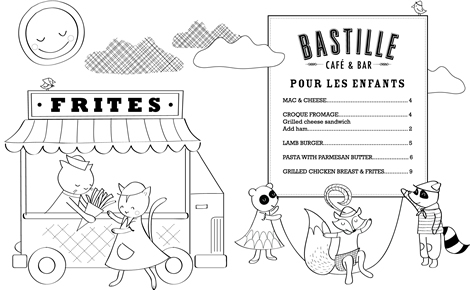
When creating menus for the eatery, it is easy to ignore the ones that are younger. The younger ones are often deciding how long the adults stay in the restaurant although yes, the grownups are the ones that are paying the bill. An upset child may equal skipping out on the dessert and leaving early. Children menus and crayons tend to be all it takes to keep children entertained in the table. Today, we revisit a place from June 2015 on “Creative Means to Keep Them Entertained and Engage Kids at Your Restaurant”.
Creative Ways to Engage Kids and Keep Them Entertained at Your Restaurant
It's a conflict both restaurant owners and parents fight - keeping children entertained at a restaurant. As a restaurant owner, you know it is a battle best fought on a united front with parents. Listed here are fun and creative ideas that will make dining at your restaurant with all the children an infinitely more enjoyable experience for everyone:
Kid-Friendly Menus
Offering colorful, action-packed kids placemat menus is a good place to start to help keep kids entertained. Kid menus may be customized to match the topic of your restaurant and can incorporate an extensive range of games including tic-tac-toe, word finds, mazes, word scrambles and more. Don't forget to offer a pack of crayons, as well.
Refined Menu Choices
Refined mightn't be a word most people would associate with children's menu alternatives but parents are expecting eateries to offer something beyond nuggets and chips for the 12-and-under set. Eateries are responding to parents' requests due to their youngsters to try out for more healthy, more intriguing alternatives.
Consider offering smaller variants of regular menu items to add variety to an otherwise ho hum kid's menu. In this way, kids feel more engaged using the complete dining experience and with all their food.
What are some ways you keep children entertained at your restaurant? Let us know in the comments below!
After researching definitions of and articles about layout, I admit that 'layout' like 'art' could be an emotionally charged word. Irrespective of how others may feel, folks in lots of fields have, and hold on to, their ‘feelings’ about layout. Wells Riley wrote, “It’s a state of mind. It’s an approach to some problem. It you’re going to kick your opponent’s butt.”
Some of the confusion about what design is appears to comes from your belief that designers are artists; professionals who focus on ‘creativity’ on a somewhat private level. Artwork could be a state of mine, nevertheless, it seldom is an approach to a problem, especially a company or technological problem. Layout, nevertheless, encompasses a universe of thought where environmental issues, functionality, aesthetics, and long-term utility become a number of its significant considerations. See Dieter Rams, Ten Principles for Great Layout
Dieter Rams also wrote, “we [designers] do’t work in a vacuum. We are in need of business people.” The consequence being that contributions from professionals in other disciplines [or other ‘company’ departments] are priceless in creating ‘successful’ layouts for theories or products. See my October 2015 Blog…, merely scroll down…
That is an interesting lead in to the annals of Impact Enterprises. Bobi Hamilton, CEO and Impact’s President, received a degree and had become a revered artist in her community. As an effect of the grade of her work, she was asked to assist several established companies with product development, marketing, and eventually promotion. Soon afterwards, her constitutional sense of company led her to build . Inc Impact Enterprises, Impact’s success can be credited to Bobi’s understanding and give attention to the actual significance of layout, not just artwork.
Today, design staff and sales associates are ’sed by Impact, discipline themselves to listen to and ‘hear that purposeful and valuable discussions ensue regarding product design and development ’ what their clients are requesting. We bring to our customer’s focus the often overlooked importance of the mixture of functionality, aesthetics, long-terms utility, and external aspects.
